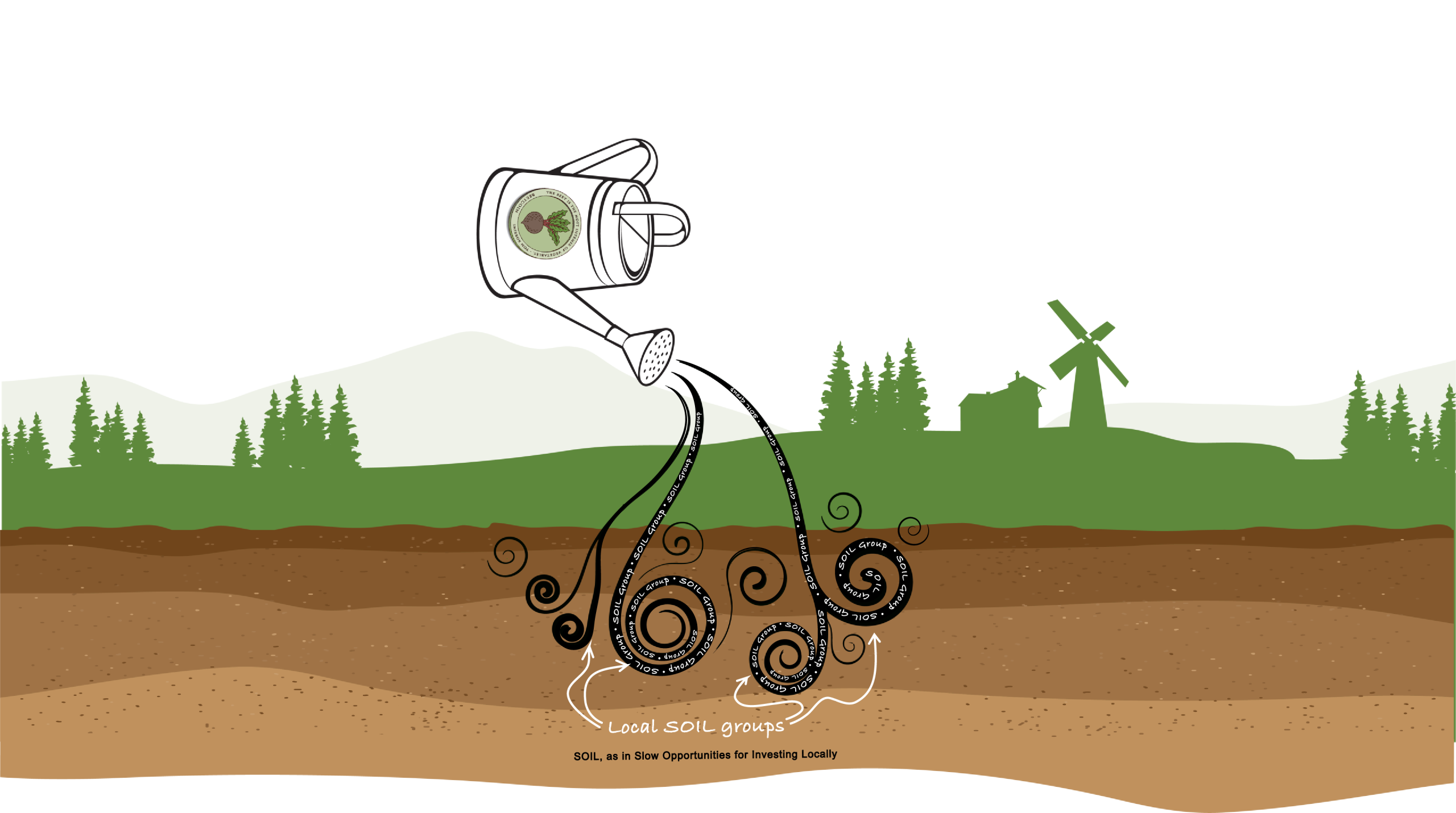
The Slow Money Institute collects Beetcoin donations and steers them to local groups as matching grants, where they work in tandem with locally raised capital. When loans are repaid, all capital stays local, recirculating in perpetuity.
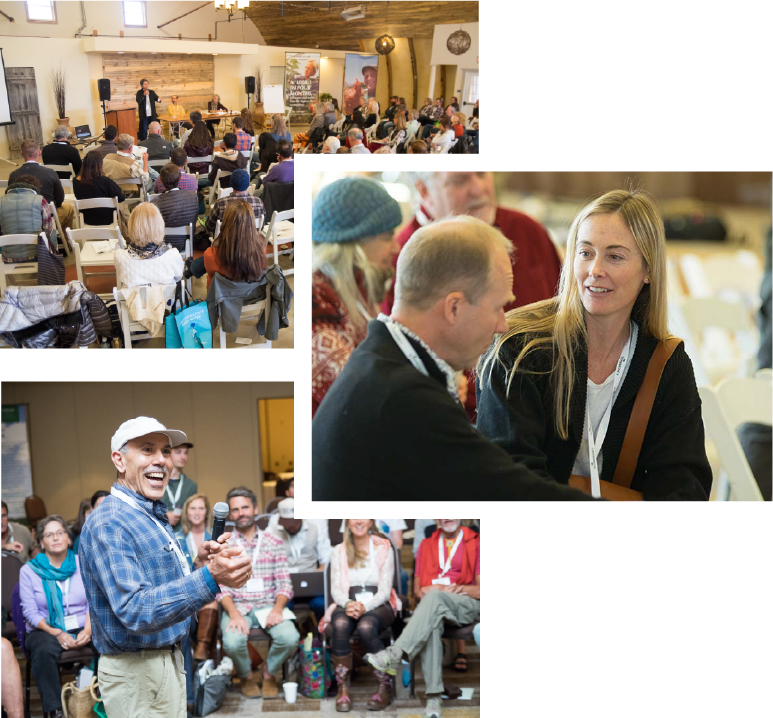
Making an individual donation or loan to an organic farm is a good thing. Doing so as part of a growing network and A MOVEMENT that promotes economic healing, an even better thing. This is bottom-up systemic change.
Linking the breadth of the internet to the depth of local knowledge. Creating slow-growing, community-driven pools of capital that catalyze grassroots participation and promote community resilience.

There are currently seven nonprofit local groups that make 0% loans. The first started in 2015 in Carbondale, CO. Over the next few years, three other groups formed in Colorado, one in Massachusetts and one in Virginia. In 2024, our newest group started in Israel.
To date, this first cohort of pioneering groups has provided $5+ million to more than 300 farms and food enterprises.
Exploratory discussions regarding new groups are underway in Rhode Island, the Netherlands, Uruguay, and China.
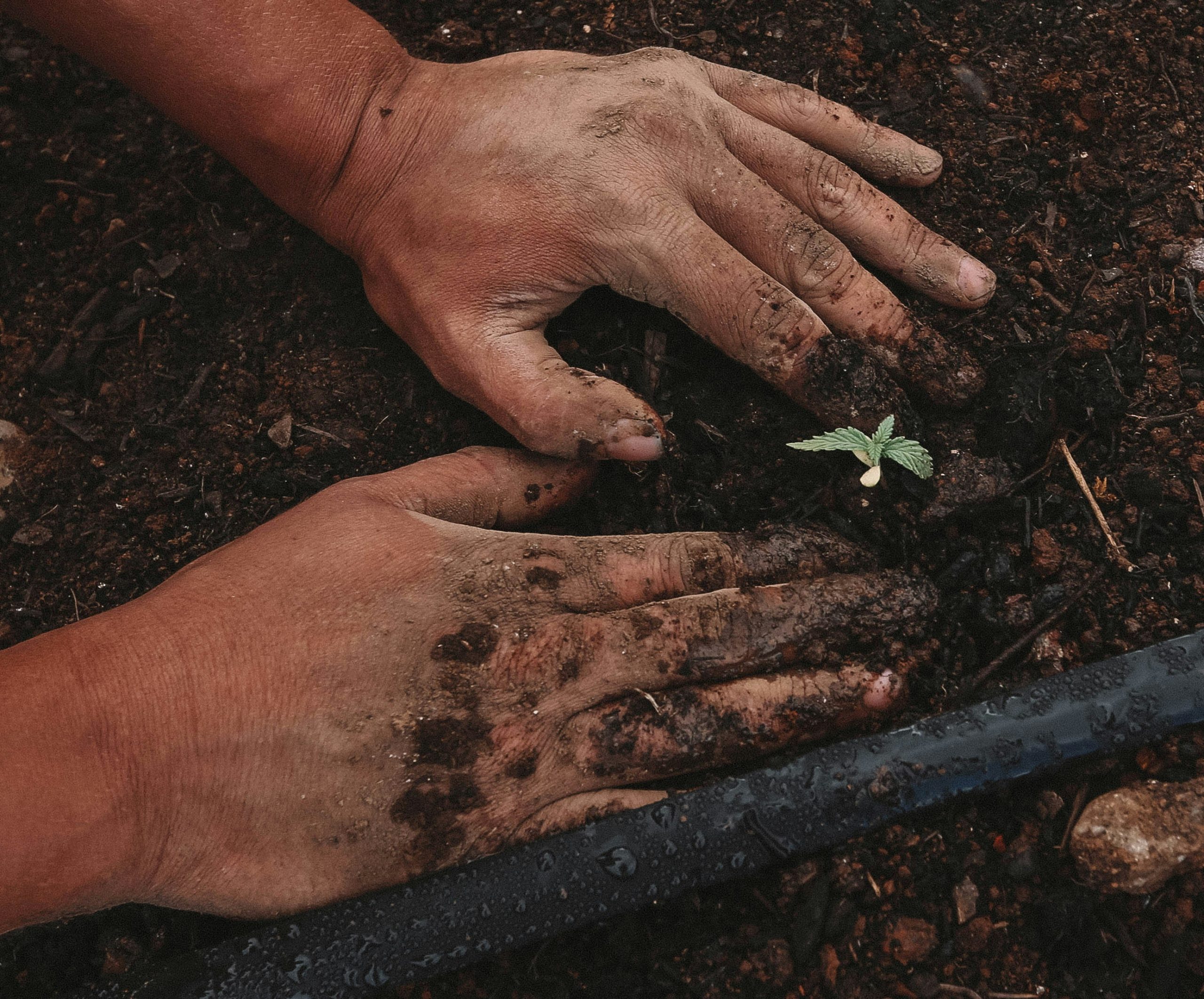
Berkshire Agricultural Ventures | Great Barrington, MA
Would you like to
0% is a clear, simple and unequivocal stand as an alternative to finance as usual. We are prioritizing people and place over the arithmetic of extraction.
Books could be written about the purpose and impact of 0% loans. Oh, wait. . .a few have been. . .
Shocker of all shockers: In professional financial circles, profit almost always comes before people and planet, no matter how earnestly triple-bottom-line concerns are expounded.
Money keeps going faster and faster, corporations keep getting bigger and bigger, wealth inequality keeps widening, the planet keeps heating up, and global markets keep taking precedence over pretty much everything.
0%, because we recognize that family farms and local food businesses are not typically very profitable, even when successful, even though they generate vital social and ecological benefits.

You can call it trust. You can call it community. It’s both of these, but it’s also conscientious affection:
"In response to military crisis, a few extraordinary souls may choose the difficult and complicated path of conscientious objection. In response to the collateral damage of globalization, the choice to become a conscientious investor is far less dramatic, far less binary, far friendlier—driven, sure, by being mad as hell and not wanting to take it anymore, but at a deeper level by a sense of conscientious affection."



Hah! This question cannot be answered without a smile. . .which is the whole point.
What we are saying is, “Enough with the dismally-dull, industrial-strength, patriarchal, command-and-control lingo of dead economists and purveyors of ultra-processed products from the financial supermarket. Enough gambling in the global casino. It’s time to make space in our hearts, minds and portfolios for an affection-riddled, healthy alternative.”
In the name of such a healthy alternative, and in the name of authentic conversation about money, we are letting go of many of the hallmarks of institutional finance.
We are making room in our financial lives for an approach to money that is mumbo-jumbo free, bold, simple, patient, urgent, pragmatic, lively, community-centered and prone to conviviality.
The Slow Money Institute is in regular contact with the groups and allocates grants to them strategically, based on their growth, the availability of Beetcoin funding and opportunities to start new local groups. The Slow Money Institute provides regular communications to Beetcoin donors on the activities of the network of local groups, and hosts online Beetcoin Dialogues.
Fifty years ago, there were only a handful of land trusts in the U.S.; today there are some 1,500. In 1986, the first CSA (community supported agriculture) in the U.S. was founded; today, there are some 7,000 CSA farms, with more than 500,000 members.
At the same time, institutional funding–investment and philanthropic–for regenerative or organic agriculture and local food systems is fragmented, top-down and extremely limited.
To promote local food systems and broader processes of localization, we would like to see hundreds of local 0% loan groups created over the next generation, in tandem with a robust international community of online supporters who recognize that family farms are key to an economy of health and peace.
Success looks like a global movement that asks the most fundamental of economic questions, while promoting direct, local, grassroots economic action.
Many initiatives have arisen in recent years under the banner of impact investing, seeking to reconcile the imperatives of maximizing shareholder value with fundamental concerns about social justice and environmental stewardship. These efforts trace their roots all the way back to Quakers’ objection to slavery in the U.S. in the 18th century and carry forward to what became known as socially responsible investing, double-bottom-line investing and triple-bottom line investing, before the current term, impact investing, came into favor today.
The problem is, of course, that the term “impact” is, particularly in the context of diversified, multi-national corporations, difficult to define clearly and measure accurately. Complex corporate data is challenging to interpret and susceptible to misunderstanding and manipulation.
Much recent effort has gone to the development of more transparent corporate reporting schemes and more nuanced investment metrics.
But the bottom line is still the bottom line. Most impact investing prioritizes “risk-adjusted” and “competitive” rates of return for investors.
The answer is deceptively simple: We want our food systems to be as organic and as local as possible. We want as few synthetic chemicals, as few petrochemicals, as few food miles as possible.
Our local loan groups do not require organic or regenerative or biodynamic certification. Nor is there a specified geographical definition of local. We rely on the collective intelligence and local knowledge of the groups, and, in most cases, the familiarity of some group members with the farms and food enterprises seeking funding.
In the absence of certification and industrial entanglements, we avoid Either/Or arguments and professional turf battles. We keep it direct and informal. As organic (small “o”) and as local (small “l”) as possible. That’s it.